The Manchester Grammar School 2017 Section B
IndependentBoys
- 11 questions
Original PDFWorked solutions in progress
- 1
When we multiply three consecutive numbers as shown below we obtain the following answer:
Using this result, work out the answers to these four questions:
- 1.a
- 1.b
- 1.c
- 1.d
Worked solutionBeing written - 2
- 2.a
The average height of three boys is . A fourth boy Stephen, whose height is , joins the group.
Find the new average height of the group.
- 2.b
Two more boys, Richard and Nigel, join the group. The new average height of all six boys in the group is .
If Richard is , how tall is Nigel?
Worked solutionBeing written - 3
The usual Olympic medal table, like the one used in Rio in , simply ranks countries in order of the number of Gold medals won.
However, the table below has been created by giving a point score to each type of medal won. The number of points awarded for each of the medals in this table is as follows:- points for every Gold medal won, points for each Silver medal won and point for a Bronze medal won.
Complete the table below by filling in the missing numbers of medals using the point scores given to the Gold, Silver and Bronze medals.
You need to know that the country of Esthopia won equal numbers of Gold, Silver and Bronze medals in order to complete the final line.
Country Gold () Silver () Bronze () Points () Abalasia Brussland Ceeden Dorway Esthopia Worked solutionBeing written - 4
In a special code, words are replaced by the product of the whole numbers assigned to the letters. In the code, each letter is given a different number.
For example:- if , and then the word
Using this same method of creating our special code, work out the answers to the following four questions:
- 4.a
If , find the values of and , if neither of the letters has the value .
- 4.b
Then with those values for and , if , find the value of .
- 4.c
Now work out the value of the word with the letter values you have, including those in the example at the start.
- 4.d
Finally, if the value of the word , work out the value of the word .
Worked solutionBeing written - 5
On a taxi journey with one particular taxi company, the fare is worked out using a set starting charge plus a charge for each quarter of a mile travelled (the QMC).
So if the starting charge is and the QMC (charge for each quarter of a mile) is then the total fare for a one mile journey is given by:
- 5.a
If the Total Fare for a two and a half mile journey at another taxi company is and the QMC (charge for each quarter of a mile) is , what is the starting charge?
- 5.b
If the starting charge at a third company is and the Total Fare for a journey is , what is the QMC?
Worked solutionBeing written - 6
The firm Owl Blocks makes rectangular wooden blocks in many sizes. For all of their blocks the length of the block is always times the width of the block. The height of the blocks isn't limited in any way.
For example, if the width of a block is then the length of the block would be because .
- 6.a
Find the length of a block if its width is .
- 6.b
Find the width of a different block if its length is .
- 6.c
Find the length of a third block if the perimeter of one of its faces measured using its length and width is .
Worked solutionBeing written - 7
The distance, , in metres, travelled by any vehicle accelerating at a rate , in is given by the formula:
or
- 7.a
Find the distance travelled by a car accelerating at a rate of for .
- 7.b
Find the distance travelled by a space rocket accelerating at a rate of for .
- 7.c
A motorbike travels in .
What is its rate of acceleration?
- 7.d
A truck travels while accelerating at a rate of .
How long does this take?
Worked solutionBeing written - 8
At “Fryers and Co” a portion of chips costs , a fish costs and a pie costs . Last Saturday evening, they sold lots of fish and chips, lots of pie and chips and portions of chips on their own.
- 8.a
Work out their total income that evening.
- 8.b
The owner bought two bags of potatoes which cost each for the chips.
He paid for each of the fish he sold and for each of the pies.
How much did the food that the owner sold that evening cost him?
- 8.c
The owner employs two staff for the evening, paying them each and they work from to . Other materials cost for the whole evening.
What are the TOTAL costs for the evening, including the food, the staff and the other materials?
- 8.d
How much profit (Income - Total Costs) did the owner make that Saturday evening?
Worked solutionBeing written - 9
The following table shows the first three rows of a table which has five columns. The values of all the entries on a particular row are the same but they are expressed in different forms.
Row Row Row Row Row Row Without necessarily completing the entire table, write down the entry that would be written in the space in the table denoted by each of the letters.
Worked solutionBeing written - 10
In a game, John has cards numbered to and five of his friends each pick two of the cards and look at the numbers on the cards they have chosen.
-
The numbers on Andy's two cards add up to .
-
The number on one of Bilal's cards is a factor of the number on his other card.
-
The number on one of Cheryl's cards is the square of the number on her other card.
-
The numbers on David's two cards are both prime.
-
The difference between the numbers on Eleanor's two cards is .
Using the information in bold type above, complete this table to show which two cards each person picked. Remember, each numbered card can only be placed in one box.
John's friends One card Other card Andy Bilal Cheryl David Eleanor Worked solutionBeing written -
- 11
The “Electric Light Organization” makes many electrical components including Zisters which control the power to any electrical appliance.
This Zister has a value of .
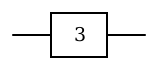 A rectangular Zister labelled 3 is connected to a wire on each side.
Zisters can be put together in two different ways as follows:
In an , the two values of the Zisters are added, so for example:
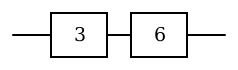 A wire passes through a Zister labelled 3 and then a Zister labelled 6.
has a value of , because .
In a , the value has to be worked out by adding fractions as follows:
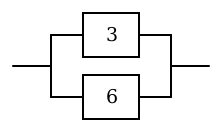 A wire splits into two branches. The upper branch contains a Zister labelled 3 and the lower branch contains a Zister labelled 6, before the branches rejoin.
Since
the value of this is , taken from the answer to the fraction sum.
- 11.a
Work out the values of the following combinations of Zisters in these two questions using the methods in the examples above.
- 11.a.i
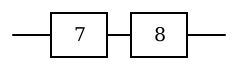 A wire passes through a Zister labelled 7 and then a Zister labelled 8.
- 11.a.ii
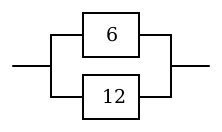 A wire splits into two branches containing Zisters 6 and 12, then rejoins.
- 11.b
Work out the value of this combination of and .
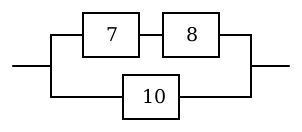 The upper branch contains Zisters 7 and 8 in series. The lower branch contains one Zister labelled 10. The branches share the same entry and exit wires.
- 11.c
Work out the value of this triple by adding three fractions.
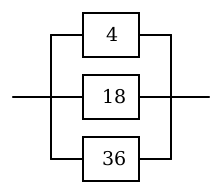 Three parallel branches contain Zisters labelled 4, 18 and 36.
- 11.d
If this new triple has a value of , work out the value of the missing Zister shown with (?)
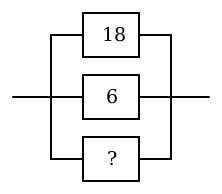 Three parallel branches contain Zisters labelled 18, 6 and question mark.
- 11.e
Finally, here is a special . Showing all your working, calculate its value. (It is special because its value is not a whole number!)
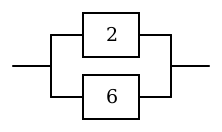 A wire splits into two branches containing Zisters 2 and 6, then rejoins.
Worked solutionBeing written